I am not here to criticize or praise any particular era. I want to understand what songs mean, explore how they relate to one another through embeddings, and follow how the story they tell unfolds along its narrative arc. Seeing that evolution laid out makes me ask: which feelings endure from one decade to the next? Which values appear, change shape, or take on a different weight?
Over the decades, the front line of what worries us has moved, and the move starts with how we perceive the city. Fear, as in the movies, first lived outside our doors, in the street, and ended up as a mantra repeating inside our heads. That shift is what I set out to follow along the narrative arc. This time I follow songs that talk about fear, from the eighties to 2026. I want to see which worries remain and what changes in the way they are told: who is afraid, what they fear, what they value, and how they respond. When I listen to albums, that mix of permanence and change is part of what draws me to following a band’s evolution. Here I try to turn that curiosity into a reading we can test and visualize.
The short answer, in this sample of 120 songs in English and Spanish:
- The threat moved inward. In the eighties, seven in ten fear songs (9.5 of 13.5) place it in society: the street, the state, war. In the 2000s the most frequent threat is someone close, usually a partner. In 2020–26, the most frequent place is one’s own mind.
- Fear stopped being narrated and started being confessed. In the eighties it usually belongs to someone else (“you”, “them”); since 2000, about eight in ten songs voice it in the first person, singular or plural (“I” or “we”). The “we” appears in the 2010s.
- The ending seems to change. Songs in which fear grows until the end decline, and songs that work through it rise, although both shifts are suggestive rather than firm (p ≈ 0.06–0.08). The obsessive loop, the chorus that never resolves, persists in every decade.
- What is protected changed. From staying safe, to dignity, and in the last decade, to healing. Love changes least: in every period, between a third and more than half of these songs protect it.
I reached those conclusions with two measurements that never see each other’s output: an anonymized reading of every lyric and the geometry of an embedding model. They are independent in execution, not in design: I chose the corpus and wrote the anchor sentences knowing the hypothesis, and the axes are validated against the readings themselves. Their agreement is what lets me state the direction of the change; where they disagree is, as we will see, the most useful lesson for anyone working with embeddings. If you came for the engineering, What embeddings see, and what they miss opens with a short technical summary.
How to read fear in a song
The corpus has 120 songs: 12 in English and 12 in Spanish in each period (1980–89, 1990–99, 2000–09, 2010–19, and 2020–26, the last one partial). I chose them before seeing any results: candidates associated with fear, ambiguous cases, and controls with no obvious fear motif. It is a purposive selection of hits with uneven reach, not a sample of all popular music. That is why I do not compare how many fear songs each decade has, which depends on who assembled the list, but what the fear is like within the songs that have it.
First measurement: an anonymized paired reading. Six reader processes, Claude Opus 5.5 subagents in Claude Code at the default sampling settings (I did not set the temperature), read every lyric without artist, title, or year, with the blocks in order and repeated choruses marked. Each song received two separate readings, which record:
- whether there is fear, explicit or implied, and whether it is affirmed or denied;
- where the threat is: society or the state, a monster or omen, another person, the loss of a bond, time, or one’s own mind;
- who is afraid: the voice, a “we”, a “you”, or a character;
- how the voice responds: flee, plead, confess, care, confront;
- the state of each block of the lyric, from threat to control, and the shape of the arc;
- what it protects: the value at stake.
The protocol is published in English and in its original Spanish. The two readings agree on whether there is fear in 95% of songs (κ = 0.90), on where the threat is in 94% (κ = 0.92), and on the shape of the arc in 82% (κ = 0.76). One important caveat: the six readers are the same assistant with the same protocol, not six people, so this agreement measures the consistency of the procedure, not independent judgment. 56 of the 120 songs carry fear according to at least one reading; 50, according to both.
Anonymized is not blind. Removing artist, title, and year does not blind a language model to Thriller or Anti-Hero. I ran a recognition test: given the same anonymized blocks, the same model named the title of 110 of the 120 songs (92%), including every fear song from 1980 to 2019. The readings can therefore carry the cultural interpretation the model absorbed about each song, and that is a risk for exactly the variable that matters most: a model that “knows” a 2019 song is about mental health can find mental health in it. The four fear songs it did not recognize are all from 2020–26 (Ansiedad, Tengo Un Pensamiento, Algo tú, Die With a Smile), so Ansiedad, the most “inside” song of that period, was read from its text alone; but four songs are too few to repeat the analysis with them. This is why the second measurement matters: an embedding only encodes the text of each block, so it is less exposed to what has been written about the song.
Second measurement: the geometry. Each block of lyrics becomes a vector with multilingual-e5-large-instruct, a local model, so no lyric ever leaves the machine. The model receives an instruction: represent what the speaker fears, where the threat comes from, and how they respond. Then I ask the space questions using anchor sentences I wrote myself. This measurement never sees the readings: it is only compared with them at the end.
From the street to the mind
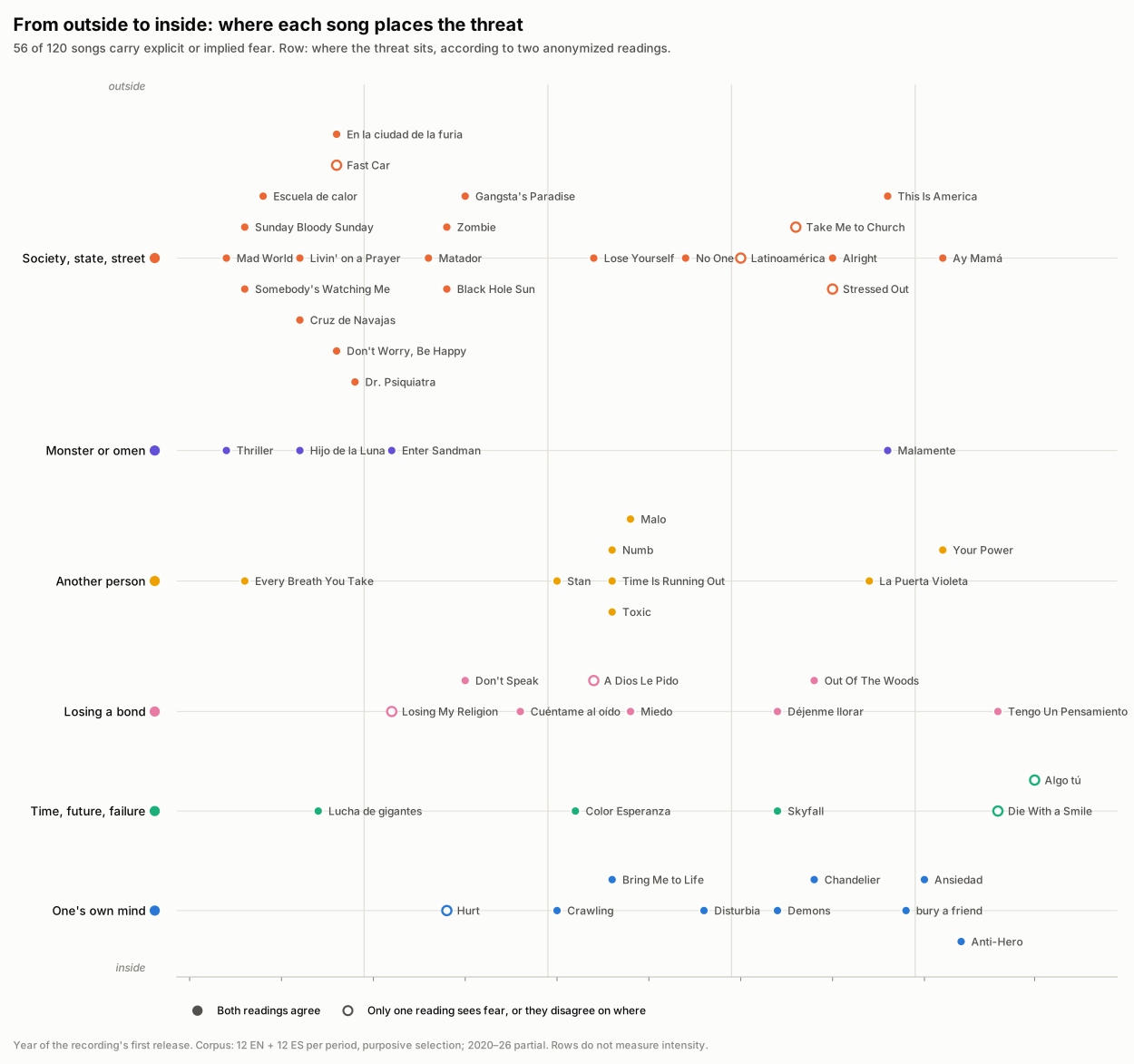
Each dot is a fear song, in the year of its first release. The row shows where the two anonymized readings place the threat; a hollow dot means only one reading sees fear or the readings disagree on where.
The figure reads top to bottom and left to right. The top row, the collective threat, clusters in the eighties and nineties. The bottom row, one’s own mind, is empty until 1994 and fills up from 2000 on.
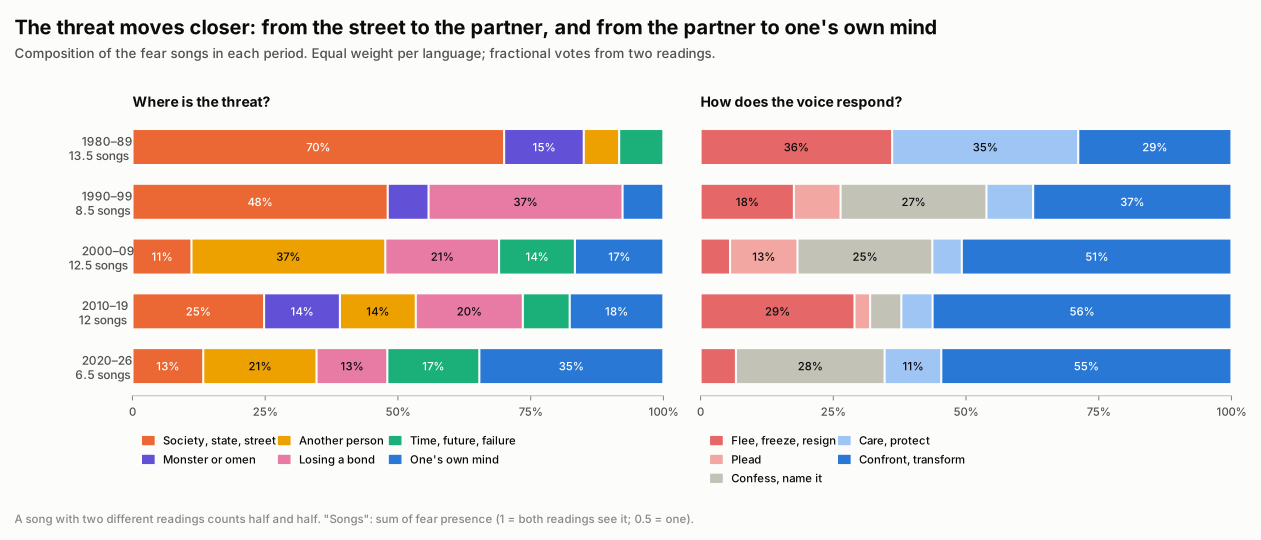
Composition of the fear songs in each period. Equal weight for English and Spanish; a song with two different readings contributes half to each category.
The percentages give English and Spanish equal weight; in parentheses, the number of songs behind them (halves appear when the two readings disagree). With 6.5 to 13.5 fear songs per period, each percentage rests on a handful of songs.
The eighties: fear has an address outside. 70% of fear songs (9.5 of 13.5) place the threat in society, the state, or the street, and another 15% (2) in a monster. Somebody’s Watching Me turns surveillance into domestic paranoia. Sunday Bloody Sunday sings of sectarian violence in Northern Ireland. Livin’ on a Prayer, Fast Car, and, beneath its mandatory cheer, Don’t Worry, Be Happy have debts, evictions, and lost jobs in the background. In Spanish: the urban night of Escuela de calor, the Buenos Aires the voice flees in En la ciudad de la furia, and the woman declared insane in Dr. Psiquiatra. The voice flees, resigns itself, or cares for someone else; it confronts in fewer than a third of cases.
The nineties: the street is still there, but the self peeks out. Collective violence persists in Zombie, Matador, and Gangsta’s Paradise, and a frightening loss appears (37%; 2.5 of 8.5 songs): Don’t Speak, Losing My Religion. With Losing My Religion and Hurt, the threat inside oneself also appears for the first time in the corpus, although in both only one of the two readings sees it that way.
The 2000s: the enemy sleeps at home. The collective threat falls to 11% (2 of 12.5). Another person dominates (37%; 5 songs), almost always someone close: a partner in Toxic, Time Is Running Out, and, in Spanish, Malo by Bebe, released the same year Spain passed its comprehensive law against gender violence (2004); an obsessive fan in Stan; someone who controls and demands in Numb. At the same time, nu-metal and gothic rock put the monster inside the head: Crawling, Bring Me to Life, Disturbia. In Latin America, crises are answered with hope or prayer: Color Esperanza, whose album came out in November 2001, weeks before Argentina’s collapse, and A Dios Le Pido.
The 2010s: the street returns, in the plural. The story is not a straight line. The collective threat rebounds to 25% (3.5 of 12) with Alright, This Is America, Latinoamérica, and Stressed Out. But in the first three the voice no longer flees: it confronts, and it does so in the plural, as “we”. Meanwhile, mental health moves to the center of pop with Demons, Chandelier, and bury a friend, which Billie Eilish described as written from the perspective of the monster under her bed, which is herself.
2020–26: fear as a state of mind. One’s own mind is the most frequent place (35%; 2 of 6.5 songs): Ansiedad, Anti-Hero. The body and other people’s power appear in Your Power and Ay Mamá. And a passing fear grows, a moment of vertigo inside a love song: Tengo Un Pensamiento, Algo tú, Die With a Smile. It is the decade with the fewest cases (6.5 fear songs), so its percentages are the most fragile.
Across the full sample, the collective threat falls 12.9 percentage points per decade (p = 0.01) and the inner threat rises 8.2 points per decade (p = 0.02). These are weighted slopes with language effects, and the p-value comes from permuting years within each language. They are two of the 18 slopes I tested; after correcting for multiple comparisons they keep q = 0.065 and 0.084 (see “What holds and what does not”).
Two languages, two paths
In English, the mind appears in the nineties and accounts for a third of fear songs from 2000 on: grunge, nu-metal, and confessional pop are, among other things, the history of that move. In Spanish it does not appear until Ansiedad, in 2020. Before that, intimate fear runs through the home and the partner (Malo, La Puerta Violeta) and through loss (Miedo, A Dios Le Pido). It is also met more often with confrontation: between 57% and 71% of Spanish fear songs since 2000 (2 to 2.5 songs out of 3.5 to 4 per decade), against 40–44% in English, and the gap appears in every decade. With two to four songs per cell, this is an observation of cases, not an estimate.
From “you” to “I”, and to “we”
Whose fear is it? In the eighties, only 33% of readings (9 of 27) attribute the fear to the singing voice; the rest belongs to a “you” being addressed (30%; 8), as in Thriller, or to characters in a story (26%; 7), as in Cruz de Navajas or Hijo de la Luna. In the 2000s, the voice confesses its own fear in 80% of readings (20 of 25). In the 2010s, 42% of readings (10 of 24) find a “we”: fear becomes collective again, but now it is sung by those who suffer it.
Counting “I” and “we” together, the fear belongs to the singer in 40% of songs in the eighties (5.5 of 13.5) and in 100% in 2010–19 (12 of 12), a rise of 12.7 points per decade (p = 0.005; q = 0.065 after correction). It is the strongest trend in the study, and it is not a quirk of this sample. DeWall and colleagues found more first-person pronouns in Billboard hits between 1980 and 2007, and Parada-Cabaleiro and colleagues, in 353,320 English lyrics, found that songs became more personal, more repetitive, and more negative. Those studies count words. Here we see what the first person does with fear: it confesses it.
The subtopics: from war and the street to mental health
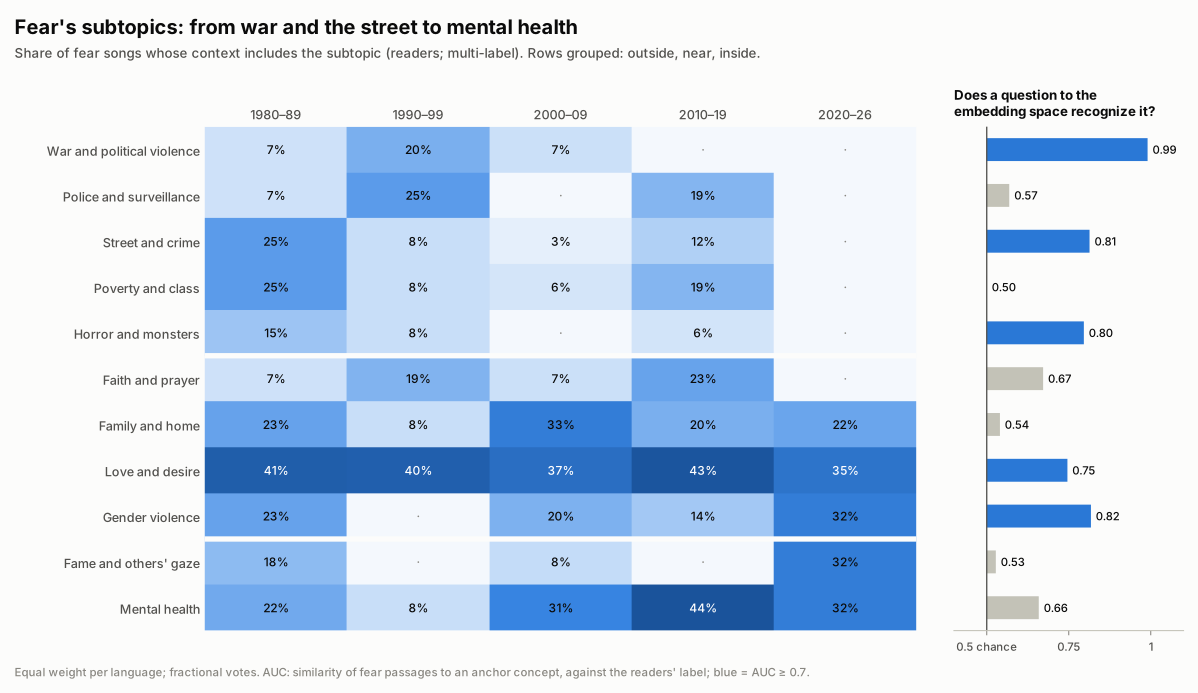
Left: share of fear songs whose context includes each subtopic, according to the readers (a song can have several). Right: whether a question to the embedding space distinguishes the songs with that subtopic.
War, police, street, poverty, and horror fill the eighties and nineties and disappear in 2020–26. Mental health is present in every decade, but it changes shape. In the eighties (22%; 3 of 13.5 songs) it is something the world does to you: the alienation of Mad World, the paranoia of Somebody’s Watching Me, the psychiatric confinement of Dr. Psiquiatra. From 2000 on (31–44%) it is one’s own mind that attacks. Love is present in every decade, between 35% and 43%: it is the most stable context of fear in popular song.
The right-hand column previews the technical part. If I ask the embedding space about a concrete scene, it recognizes it well: war (AUC 0.99, though with only 4 songs), control in a relationship (0.82), street and crime (0.81), monsters (0.80). If I ask about an abstract condition, it fails: poverty (0.50), fame (0.53), family (0.54). The model recognizes a scene better than a social structure.
What embeddings see, and what they miss
The short version, for engineers.
- Multilingual embeddings sort lyrics by language first: until each language’s mean is removed, 100% of a song’s nearest neighbors share its language.
- Free structure does not recover the concept. UMAP, clustering, and nearest neighbors group passages by scene, vocabulary, and chorus; a 10-nearest-neighbor classifier scores below the majority baseline (59% vs 65%).
- An explicit question does. An axis built from bilingual anchor sentences separates “inside” from “outside” songs with AUC 0.89 [0.79–0.96] and reproduces the readers’ trend without seeing their labels.
- The instruction prefix does not measurably help: its gain over the same model is within bootstrap noise.
- Embeddings place a lyric better than they follow it: within a song, the correlation with the readers’ states is 0.15.
- An LLM reader is not blind: it recognized 92% of the anonymized lyrics.
A natural first attempt is to let the subtopics of fear emerge on their own, with BERTopic over the embeddings. When I tried it, the groups were mostly language and vocabulary. Here is why, and what works instead.
1. The first thing an embedding sees is the language
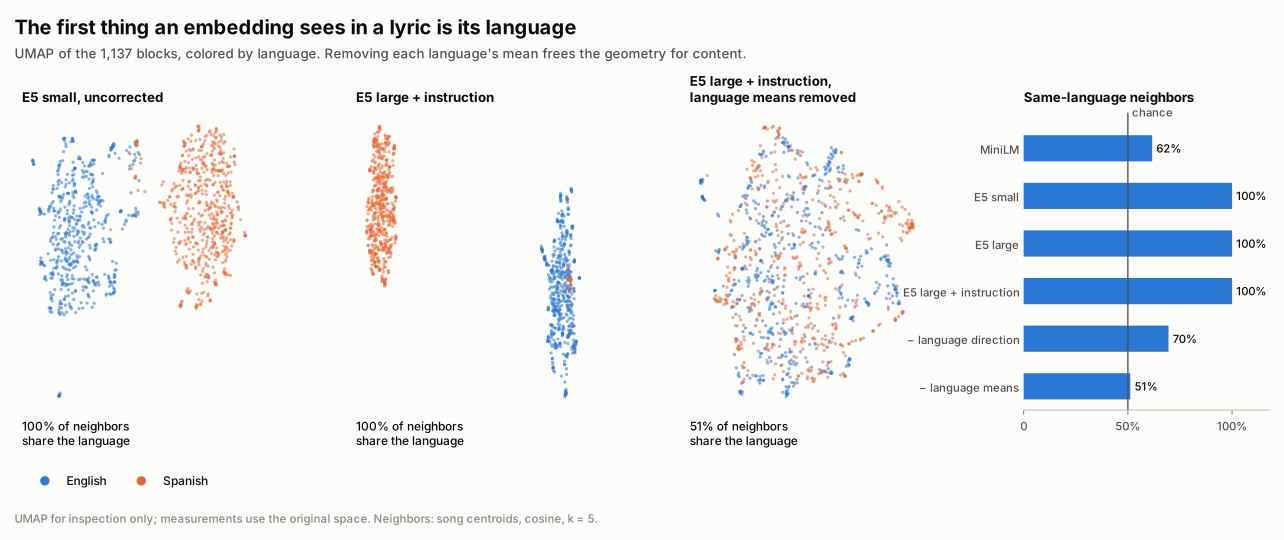
Uncorrected, the five nearest neighbors of every song are in its own language. Removing each language’s mean brings that share back to chance.
With E5 small and E5 large, 100% of each song’s five nearest neighbors are in its own language. The map separates English from Spanish before anything else. The fear instruction alone does not fix it. Removing each language’s mean, as Libovický, Rosa, and Fraser propose, brings that share down to 51%, that is, to chance. Any analysis of bilingual lyrics that skips this step will discover, with great confidence, that English and Spanish are different.
2. The free map does not answer the question
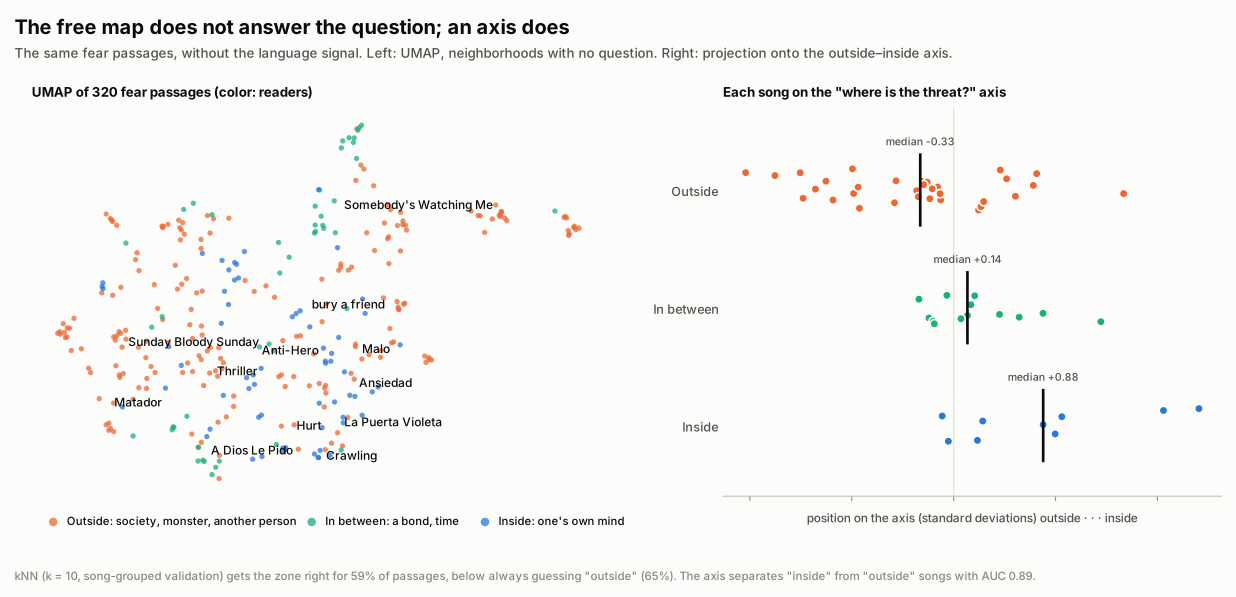
The same fear passages, without the language signal. The free map shows tendencies without borders; the axis separates the zones the readers marked.
Without the language signal, free clustering of songs becomes unstable (bootstrap ARI ≈ 0.4) and barely resembles the readers’ categories (NMI ≈ 0.3). The neighbors of a fear passage share a scene, vocabulary, or a chorus, but not the location of the threat. A 10-nearest-neighbor classifier gets the zone right for 59% of passages, less than the 65% you get by always answering “outside”. UMAP and BERTopic remain good for exploring, but they do not measure a concept nobody asked them about.
3. Asking with axes
What does work is asking an explicit question. For each dimension I wrote two poles of 16 anchor sentences: 8 in English and 8 in Spanish, parallel translations, all in the first person and with explicit fear, so that only what I want to measure changes. Some examples: I’m afraid of the stranger who keeps spying on my house versus I’m scared of my own thoughts, or I hide and wait for it to pass versus I’m scared, but I stand up and face it. The axis is the difference between the two poles, an idea that comes from Kozlowski, Taddy, and Evans’s geometry of culture and from SemAxis. Each lyric is projected onto it.
| AUC against the readings [90% interval] | Outside → inside | Collective threat | Flee → confront |
|---|---|---|---|
| Multilingual MiniLM | 0.77 [0.61–0.91] | 0.77 [0.65–0.88] | 0.54 [0.38–0.70] |
| E5 small | 0.79 [0.64–0.92] | 0.73 [0.61–0.84] | 0.69 [0.55–0.83] |
| E5 large instruct, no instruction | 0.85 [0.74–0.94] | 0.80 [0.69–0.89] | 0.69 [0.54–0.84] |
| E5 large instruct, with fear instruction | 0.89 [0.79–0.96] | 0.85 [0.74–0.93] | 0.72 [0.57–0.85] |
| Songs compared | 10 inside vs 34 outside | 22 collective vs 34 other | 22 confront vs 17 flee |
With 56 songs, the intervals are wide. In paired bootstrap comparisons, which resample the same songs for every encoder, the instructed large model beats MiniLM on all three axes and E5 small on two. But its gain of 0.02 to 0.05 over the same model without the instruction is within noise: those intervals include zero (+0.035 [−0.012, +0.085] on the outside→inside axis). I cannot claim that the instruction helps. On the anchors themselves, the outside→inside axis correctly classifies 100% of the sentences held out when building it.
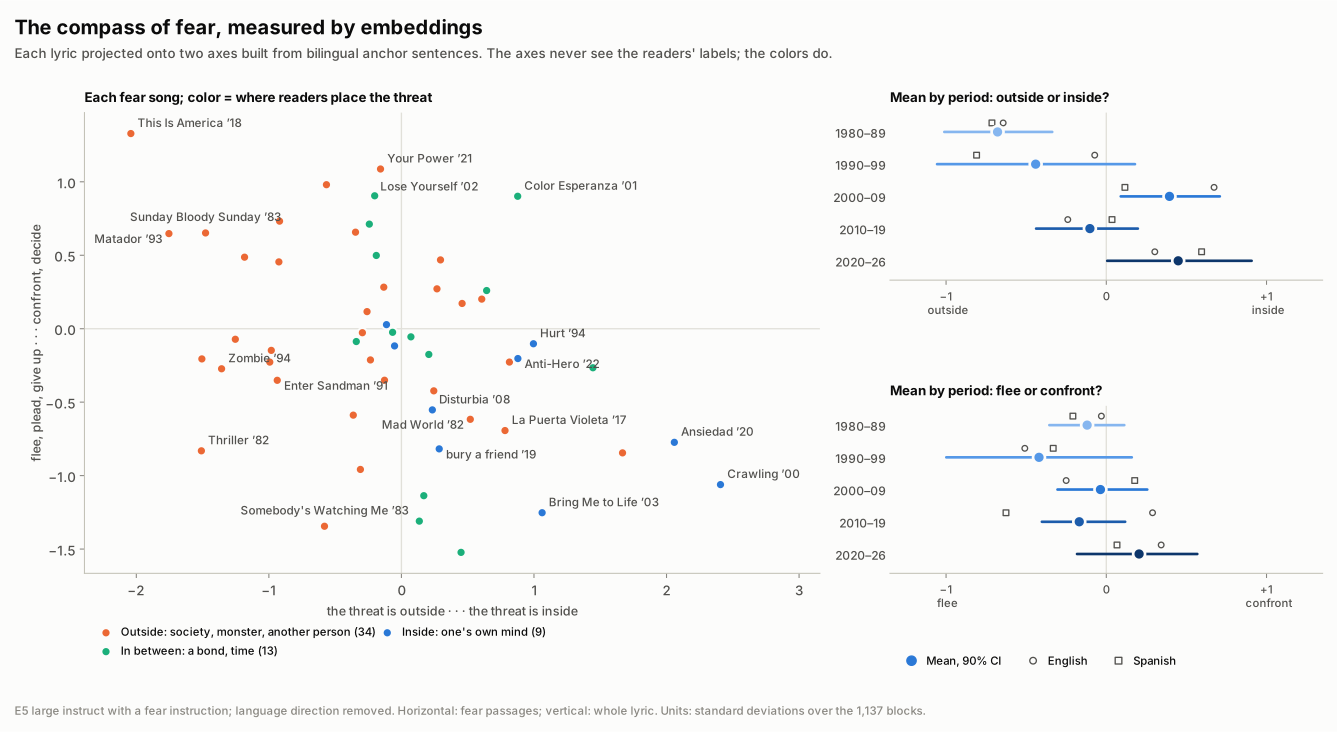
The geometry never sees the readers’ labels; the colors do. Songs the readers read as inside sit on the right. On the right of the figure, period means: the outside→inside shift, with the street returning in the 2010s.
Without looking at a single label, the outside→inside axis moves +0.23 standard deviations per decade (p = 0.01; q = 0.065). The direction holds for all four encoders, between +0.20 and +0.27 (p ≤ 0.024), and it reproduces the readers’ zigzag: forward in the 2000s, back in the 2010s, forward again. The agency axis barely moves (p = 0.21). The geometry captures where the threat is better than how the voice responds.
The arc: how fear moves inside a song
A topic describes what a song is about; an arc describes what happens to the voice while it sings. That lyrics have arcs is already known: Alberhasky and Durkee, working with 12,280 lyrics, found that songs set the scene, advance the plot, and concentrate tension in the middle, like the stories studied by Boyd, Blackburn, and Pennebaker. My question is narrower: what happens to the voice’s fear along that arc. To see it, each reader assigned a state to every block of the lyric, from threat (red) to control (blue), in the order it is sung.
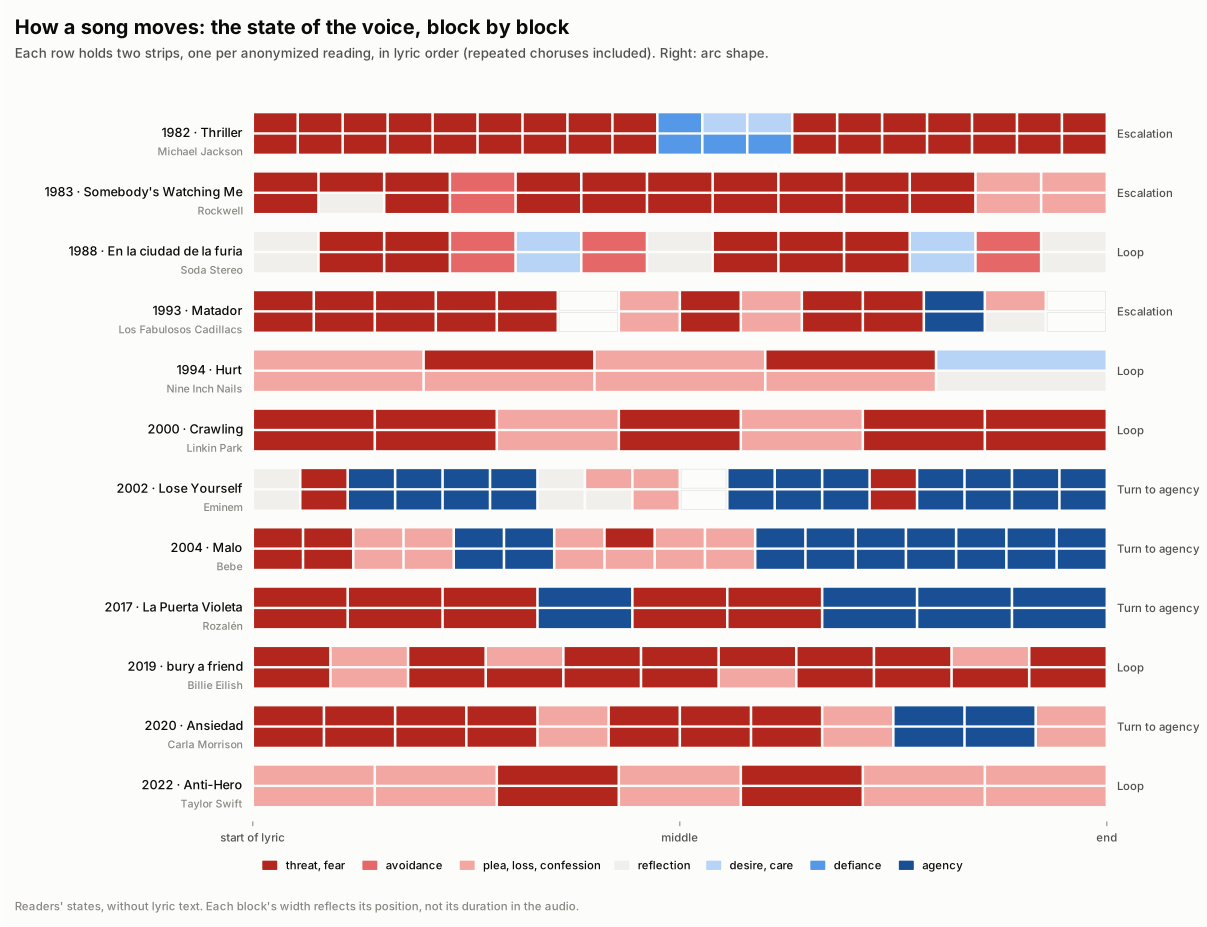
Each row holds two strips, one per anonymized reading, in lyric order with repeated choruses included. Red: threat or fear; blue: defiance or agency.
The strips make visible what an average hides. Thriller and Somebody’s Watching Me start red and end red: the fear grows. Crawling, bury a friend, and Anti-Hero alternate red and pink without getting out: they are loops, the chorus as obsession. Lose Yourself, Malo, La Puerta Violeta, and Ansiedad start red and end blue: the voice works through the fear.
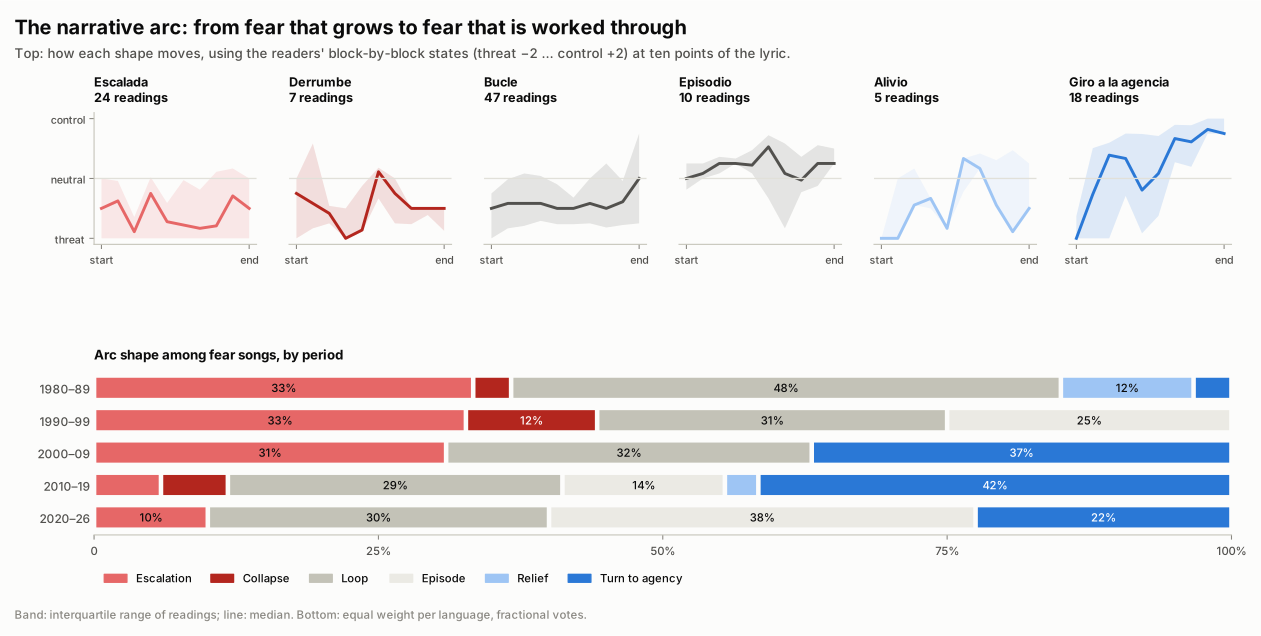
Top: how each arc shape moves along the lyric. Bottom: the share of fear songs with each shape in each period.
In the eighties and nineties, a third of fear songs escalate (4.5 of 13.5 and 2 of 8.5 songs). Since 2010 only 6% to 10% do (1 of 12 and 0.5 of 6.5). The turn to agency goes from almost nonexistent (0.5 of 13.5 songs, then none) to the most frequent shape in 2000–09 and 2010–19 (37% and 42%; 3.5 songs in each). Both shifts are suggestive, not firm: −7.7 and +6.5 points per decade, with p = 0.06 and 0.08 (q = 0.155 after correction). The loop barely changes: after 48% in the eighties (6.5 of 13.5), it hovers around 30% in each decade. And in 2020–26 episodic fear grows (38%; 3 of 6.5 songs; +6.9 points per decade, p = 0.01, q = 0.065), the moment of vertigo inside a love song.
Can embeddings draw these arcs on their own? Only halfway. The correlation between the readers’ state and each block’s position on the agency axis is 0.32 overall, but 0.15 on average within a single song. The vector knows which zone a lyric is in, but it follows its movement poorly. The arc still needs reading.
What the voice protects
I was interested in one more question: what makes something valuable to the person singing. Fear is a good way in, because what we fear is always losing something.
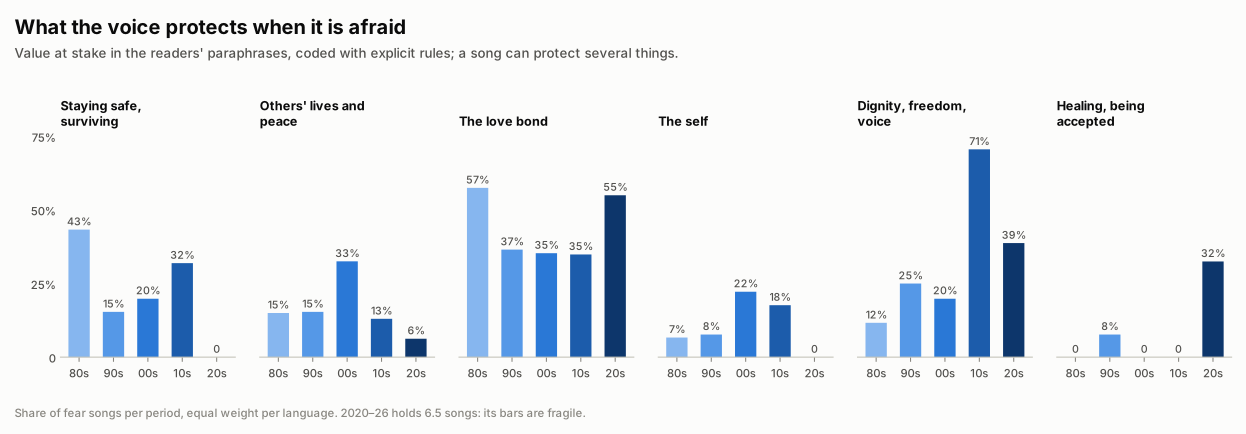
Value at stake in the readers’ paraphrases, coded with explicit keyword rules. A song can protect several things.
Staying safe (privacy, refuge, surviving the night) dominates the eighties (43%; 6 of 13.5 songs) and disappears in 2020–26. The self (self-control, identity, feeling alive) grows in the 2000s (22%; 4 songs, all in English), with Crawling and Bring Me to Life. Dignity, freedom, and voice reaches 71% in 2010–19 (7 of 12 songs: every Spanish fear song of the decade and 3.5 of 8.5 in English; the percentage gives each language equal weight): Alright, This Is America, La Puerta Violeta, Take Me to Church. Healing and being accepted belongs almost entirely to the last decade (32%; 2 of 6.5 songs): being able to speak and breathe in Ansiedad, being loved despite one’s flaws in Anti-Hero. And the love bond runs through the whole period, between 35% and 57%: it is what is most protected in four of the five decades.
Read in sequence, it tells another version of the same move: first the body is protected, then identity and dignity, and finally health. This coding describes the readers’ paraphrases; it is not an independent measurement, and the last decade has few cases.
What holds and what does not
- Holds. With only the 50 songs in which both readers see fear, every trend holds or strengthens: inner threat +9.2 points per decade (p = 0.01), collective threat −13.5 (p = 0.008). All four encoders reproduce the outside→inside axis.
- Weakens. 24 of the 56 fear songs were chosen because of fear. Without them, 32 remain, and the direction holds: inner threat +3.5 points per decade, collective −10.9, axis +0.20 SD per decade. But the evidence weakens (p between 0.07 and 0.37). Part of the contrast came from the selection. What supports the direction, not the magnitude, is its agreement with studies of thousands of lyrics.
- Multiple comparisons. I tested 18 slopes. After a Benjamini–Hochberg correction, the five strongest results (fear sung in the first person, the collective threat, the geometric outside→inside axis, episodic fear, and the inner threat) have q between 0.065 and 0.084: they survive a 10% false discovery rate, not a 5% one. Everything with p > 0.05 (escalation, the turn to agency, confrontation as a response) should be read as suggestive.
- Is fragile. 2020–26 has 6.5 fear songs, and the language splits have two to four songs per cell.
- Is not blind. The readers are the same model, and that model recognizes 92% of the anonymized songs, so their agreement is not equivalent to that of different people and their readings can carry what the model already knew about each song. The geometric axis, which reads only text, is the measurement least exposed to that bias, and it points the same way.
- Is not measured. I read lyrics: not audio, vocal performance, or reception. A release year is not a listening year.
What endures and what changes
Love endures as what fear protects, and the loop endures: in every decade, at least three in ten of these songs circle their fear without resolving it, because a chorus can also be a way of staying stuck.
The place of the threat changes: it moved from the street to the home and from the home to the mind. The person who fears changes, from the narrated “you” to the “I” who confesses. The ending seems to change: songs appear to learn to work through fear as well as suffer it, although that shift is suggestive rather than firm. And what is protected changes: from surviving, to being dignified, and now to healing.
In the eighties, fear was something that happened outside and that the song narrated. In the 2020s, it is something that happens inside and that the song confesses, sometimes in order to get out of it.
For anyone working with embeddings, the lesson fits in two steps: first, remove the language; then, ask. A free map offers neighbors, and the neighbors of a lyric share a scene, vocabulary, or a chorus. An anchored direction, validated against an independent reading, answers the question you bring. And when what you want to measure is a movement inside the song, like an arc, you have to go back to reading. If the reader is a language model, test what it already knows first: anonymizing is not blinding.
Method, data, and reproduction
- Corpus. 120 lyrics with integrity hashes, from LRCLIB and Genius. The lyrics stay in a private cache; the public materials contain IDs, categories, scores, and short paraphrases without quotations. Year: first commercial release of the included recording.
- Reading. Protocol in English (original in Spanish). Six reader processes (Claude Opus 5.5 subagents in Claude Code, default sampling settings, temperature not set), 40 cases each, randomly assigned (seed 20261012), so every song has two readings from different readers. Recognition test: the same model, given the same anonymized blocks, named 110 of the 120 titles. A validator checks the schema, the IDs, and the order of the arc steps. Aggregation by fractional vote.
- Blocks. Up to eight lines and at least four words, in order: 1,333 blocks with repetitions, 1,137 unique.
- Embeddings.
intfloat/multilingual-e5-large-instruct(1,024 dimensions, local), with and without the fear instruction. Multilingual MiniLM and E5 small for comparison. Language removed by centering (for neighborhoods and clustering) or by projecting out a direction estimated from parallel anchors (for axes and concepts). - Axes and concepts.
semantic-anchors.json, written before projecting the lyrics. Internal validation (held-out anchors) and external validation (AUC against the readings, with 90% bootstrap intervals and paired differences between encoders). - Trends. Period means with equal weight per language. Slope per decade by weighted least squares, with language effects. p-values from 10,000 permutations of years within each language, with Benjamini–Hochberg q-values across the 18 slopes. 90% bootstrap intervals resampling songs.
- Reproduce.
embed_instruct.py→fear_story.py→visualize_story.py --lang en. Public results are inresults/story-v3.