Abstract
This study traces the lyrical evolution of the Beatles across four albums — Rubber Soul (1965), Revolver (1966), Sgt. Pepper’s Lonely Hearts Club Band (1967) and Abbey Road (1969) — using a pipeline of LLM-driven topic modeling (BERTopic), a vector database (OpenAI text-embedding-3-large indexed in ChromaDB), embedding geometry, and graph theory. The study puts a falsifiable question to the canonical critical narrative — that the Beatles moved through four discrete stylistic eras — by testing whether the albums occupy separable territories in lyrical-semantic space.
Core Finding (data-driven, falsifiable): The four albums are statistically detectable but practically inseparable in lyrical-semantic space. A silhouette of album labels over song embeddings is ≈ 0 (−0.011) yet significantly above a shuffled null (null μ = −0.024, p = 0.004); the modularity of the album partition on the song-similarity graph is Q = 0.060 — again above chance (null μ = −0.017, p = 0.007) but near-zero in absolute terms. Against this, Louvain community detection finds a real cross-cutting structure at Q = 0.348 that does not respect album boundaries (community-vs-album ARI = 0.090, NMI = 0.208; 69% of edges connect songs from different albums). The only monotonic signal is lexical: pooled per album, type-token ratio rises 0.156 → 0.236 (r = +0.93 vs release order) and the hapax ratio 0.364 → 0.538 (r = +0.95). But this is an aggregation effect — at the song level (n = 58, length-controlled OLS) the trend dissolves (β_order p = 0.15 for hapax, p = 0.88 for TTR). The evolution is real, but it is a single semantic register slowly diffusing, not a sequence of separable thematic eras.
TL;DR
- Topic modeling per album (BERTopic over a shared topic space, OpenAI-embedding backend,
gpt-4o-minilabels) is the descriptive entry point — but thematic concentration does not trend monotonically (Sgt. Pepper’s is the most topically diverse, Abbey Road the most concentrated). The evolution does not live in the topic mix. - Vector database + embedding geometry: songs embedded with
text-embedding-3-large(3072-dim), indexed in ChromaDB. Drive My Car — the opener of the earliest album — has its nearest neighbours in later albums. Album membership is not what organizes the space. - Albums are detectable but not separable: silhouette ≈ 0 (p = 0.004), album-partition graph modularity Q = 0.06 (p = 0.007). Real, but negligible.
- Graph theory (the centrepiece): a song-similarity network with Louvain communities at Q = 0.35 that cut across albums (ARI = 0.09). The structure that exists is a soft early (Rubber Soul + Revolver) vs late (Sgt. Pepper’s + Abbey Road) gradient, with bridge songs — A Day in the Life and Got to Get You into My Life — holding the catalogue together by betweenness centrality.
- Lexical diversification is real per album (r > 0.93) but not per song (p > 0.14) — later albums reuse fewer words across their songs; diffusion, not enrichment.
- The arc: Sgt. Pepper’s is the only album with genuine internal cohesion (concept-album geometry); Abbey Road is the most internally fragmented (the medley as a patchwork).
What This Post Does
This analysis does four things. First, it starts where the brief asked — topic modeling per album with BERTopic — and shows honestly why, on a corpus this small, topic modeling is a descriptive entry point rather than the load-bearing method. Second, it embeds every song and line with OpenAI’s text-embedding-3-large, indexes them in a vector database (ChromaDB), and measures the geometry of the evolution. Third, it builds the song-similarity graph and uses graph theory — Louvain communities, modularity, betweenness — to ask whether semantic structure respects album boundaries (it does not). Fourth, it submits the two load-bearing claims to statistical scrutiny: song-level regressions and permutation tests, because four album means cannot carry inference on their own.
The design is confirmatory, not exploratory: the hypothesis under test is the received critical narrative itself, and its central claim is operationalized as a pre-specified geometric prediction. The result is more nuanced — and more honest — than restating that narrative would have been.
Why This Matters
The received story of the Beatles is one of dramatic evolution: the folk-rock introspection of Rubber Soul, the studio experimentation of Revolver, the psychedelic concept-album peak of Sgt. Pepper’s, the mature synthesis of Abbey Road. That story is true at the level of production, arrangement and cultural reception. The question this post asks is narrower and testable: does that evolution show up in the lyrics, as semantic structure that separates the albums?
This matters beyond Beatles fandom. It is a clean test of what distributional embeddings can and cannot see in a famously evolving body of text — the same epistemic question that runs through this series (Beatles vs. Pink Floyd; Aquamosh). If even the Beatles’ canonical “evolution” is, at the lyrical-semantic level, a slow diffusion within one register rather than a march between separable worlds, that is a substantive finding about both the music and the measuring instrument.
Research Design: Testing the Canon, Not Fishing for a Story
The popular and critical history of the Beatles hands us a strong, falsifiable hypothesis we did not have to invent: that the band moved through four discrete stylistic eras — folk-rock introspection, studio experiment, psychedelia, mature synthesis — each album a world of its own. We take that canonical narrative as the hypothesis under test (H1) and operationalize its central claim geometrically: if the eras are discrete, the four albums must occupy separable territories in lyrical-semantic space — a positive silhouette of album labels, album-aligned community structure, and an album-partition modularity well above chance. Those signatures are fixed before the test, and each is checked against a permutation null.
The analysis is therefore confirmatory, not exploratory: we are falsifying a pre-existing public claim against the geometry of lyrical information, not mining the data for whatever pattern it happens to hold. The strong form of H1 is rejected — the albums are statistically detectable but practically inseparable — and only a weak residual form survives. One secondary observation, the per-song dissolution of the album-level lexical trend, is genuinely abductive; we label it as such rather than dress it as a prediction. Distinguishing the two is the point: the headline claim is a falsification of the canon, and the abductive thread is flagged as the hypothesis-generating coda it actually is.
Methodology
Data Collection
Albums (chronological — the spine of the arc):
| Album | Year | Songs | Lines | Words |
|---|---|---|---|---|
| Rubber Soul | 1965 | 14 | 464 | 2,922 |
| Revolver | 1966 | 14 | 455 | 2,399 |
| Sgt. Pepper’s Lonely Hearts Club Band | 1967 | 13 | 544 | 3,094 |
| Abbey Road | 1969 | 17 | 403 | 2,255 |
| Total | 58 | 1,866 | 10,670 |
Source: Genius API via the lyricsgenius library. Album-level search is unreliable for the Beatles — it merges compilations, singles, and foreign-language versions (Sgt. Pepper's came back as a 216-“track” collection mixing in Abbey Road songs, Hey Jude, and Komm, gib mir deine Hand). We therefore fetch song by song against canonical UK tracklists, which is fully reproducible. Lyrics are cleaned of section markers ([Chorus]) and CMS noise (NNNEmbed, “Contributors”).
Embeddings + Vector Database
Each song’s full lyric and each individual line is embedded with OpenAI text-embedding-3-large (3072-dim), cached to disk, and the 58 song vectors are indexed in a persistent ChromaDB collection with cosine space.
def embed_texts(client, texts, batch=64):
    out = []
    for i in range(0, len(texts), batch):
        chunk = [t.replace("\n", " ") for t in texts[i:i+batch]]
        resp = client.embeddings.create(input=chunk, model="text-embedding-3-large", dimensions=3072)
        out.extend([d.embedding for d in resp.data])
    return np.asarray(out, dtype=np.float32)

coll = chromadb.PersistentClient(path=CHROMA).create_collection(
    "beatles_songs", metadata={"hnsw:space": "cosine"})
coll.add(ids=ids, embeddings=song_emb.tolist(), metadatas=metas, documents=texts)
A first clue arrives immediately from the vector DB. Querying the nearest neighbours of Drive My Car — the opener of the earliest album — returns songs from later albums:
Nearest neighbours of 'Drive My Car' (Rubber Soul):
   And Your Bird Can Sing      Revolver        cos_dist=0.421
   Got to Get You into My Life Revolver        cos_dist=0.438
   A Day in the Life           Sgt. Pepper's   cos_dist=0.449
Album membership is not what organizes the space. The rest of the post quantifies that.
Engineering note. Under this environment’s NumPy 2.4,
numba(and therefore UMAP) is unavailable, so BERTopic runs on a scikit-learn PCA + HDBSCAN backend and all 2-D projections use scikit-learn t-SNE/PCA. All LLM work uses OpenAI (gpt-4o-mini); the Gemini key was non-functional.
1 · Topic Modeling per Album (BERTopic) — The Descriptive Entry Point
The albums are small (~400–540 lines), so per-album HDBSCAN is unstable. We fit one BERTopic model over all 1,866 lines using the precomputed OpenAI embeddings — a shared topic vocabulary in which the albums are directly comparable — then read each album’s distribution over the shared topics. Topics are auto-labelled by gpt-4o-mini from their top words and exemplar lines.
The resulting topic landscape is legible: Ambition and Heartbreak, Sgt. Pepper’s Band, dreamlike imagery (Lucy in the Sky), yellow submarine, Doctor theme, violence and desperation (Maxwell’s Silver Hammer / Run for Your Life), Morning greetings, unity and togetherness (Come Together). On a corpus this small, ~57% of lines fall to HDBSCAN’s outlier bucket and are kept out of the per-album profile rather than force-assigned into a single generic mega-topic.
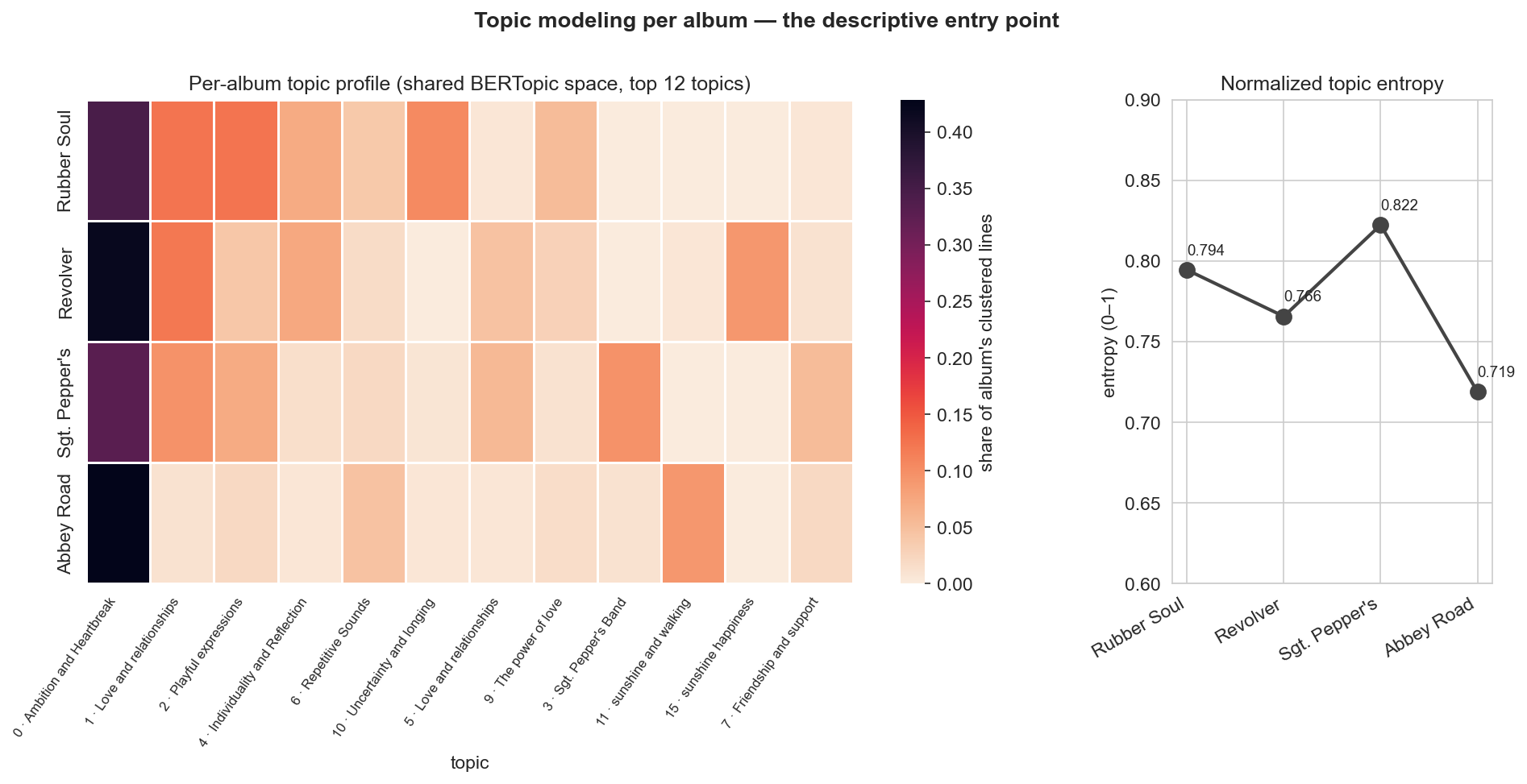
Per-album thematic concentration (normalized topic entropy over clustered lines):
| Album | Topics present | Top-topic share | Topic entropy (0–1) |
|---|---|---|---|
| Rubber Soul | 14 | 0.346 | 0.795 |
| Revolver | 13 | 0.420 | 0.766 |
| Sgt. Pepper’s | 17 | 0.330 | 0.822 (most diverse) |
| Abbey Road | 19 | 0.429 | 0.719 (most concentrated) |
Key finding (NEGATIVE, and instructive): thematic concentration does not trend monotonically with time. If the “increasing complexity” intuition were a topic-distribution fact, entropy would climb toward Abbey Road. Instead Sgt. Pepper’s is the most topically diverse and Abbey Road the most concentrated — the latter because the Side-B medley repeats a handful of motifs (“carry that weight”, “love you”). Topic modeling tells us the evolution does not live in the topic mix. This is exactly the limitation flagged in the Aquamosh post: topic models need large corpora; 13–19 songs cannot yield a stable thematic trajectory. So we move to geometry.
2 · Embedding Geometry — Where the Evolution Actually Lives
Far more robust than topic modeling on this corpus. Per album, in chronological order, we measure intra-album cohesion (mean pairwise cosine among its songs), dispersion (distance to centroid), nearest-neighbour album purity, centroid drift, lexical diversity, and within-song repetition.
| Album | Intra-cohesion | NN-purity (k=1) | TTR | Hapax ratio | Adj-line cos |
|---|---|---|---|---|---|
| Rubber Soul | 0.459 | 0.500 | 0.156 | 0.364 | 0.359 |
| Revolver | 0.450 | 0.214 | 0.208 | 0.411 | 0.354 |
| Sgt. Pepper’s | 0.481 | 0.615 | 0.231 | 0.531 | 0.335 |
| Abbey Road | 0.399 | 0.118 | 0.235 | 0.538 | 0.414 |
Two things jump out.
(a) Lexical richness rises monotonically — at the album level. Type-token ratio climbs 0.156 → 0.208 → 0.231 → 0.236 (Pearson r = +0.93 vs release order); the hapax ratio (share of words used exactly once) climbs 0.364 → 0.411 → 0.531 → 0.538 (r = +0.95). Pooled per album, the Beatles’ vocabulary becomes steadily richer and less repetitive.
(b) Album cohesion is not monotonic — it is a Sgt. Pepper’s spike. Sgt. Pepper’s has the highest internal cohesion (0.481) and the highest nearest-neighbour purity (0.615): its songs are each other’s nearest neighbours far more than chance — the geometry of a concept album. Abbey Road has the lowest purity (0.118): only ~1 in 9 of its songs has its nearest neighbour on the same record — the most internally heterogeneous album, exactly as a medley of stylistic fragments should be.
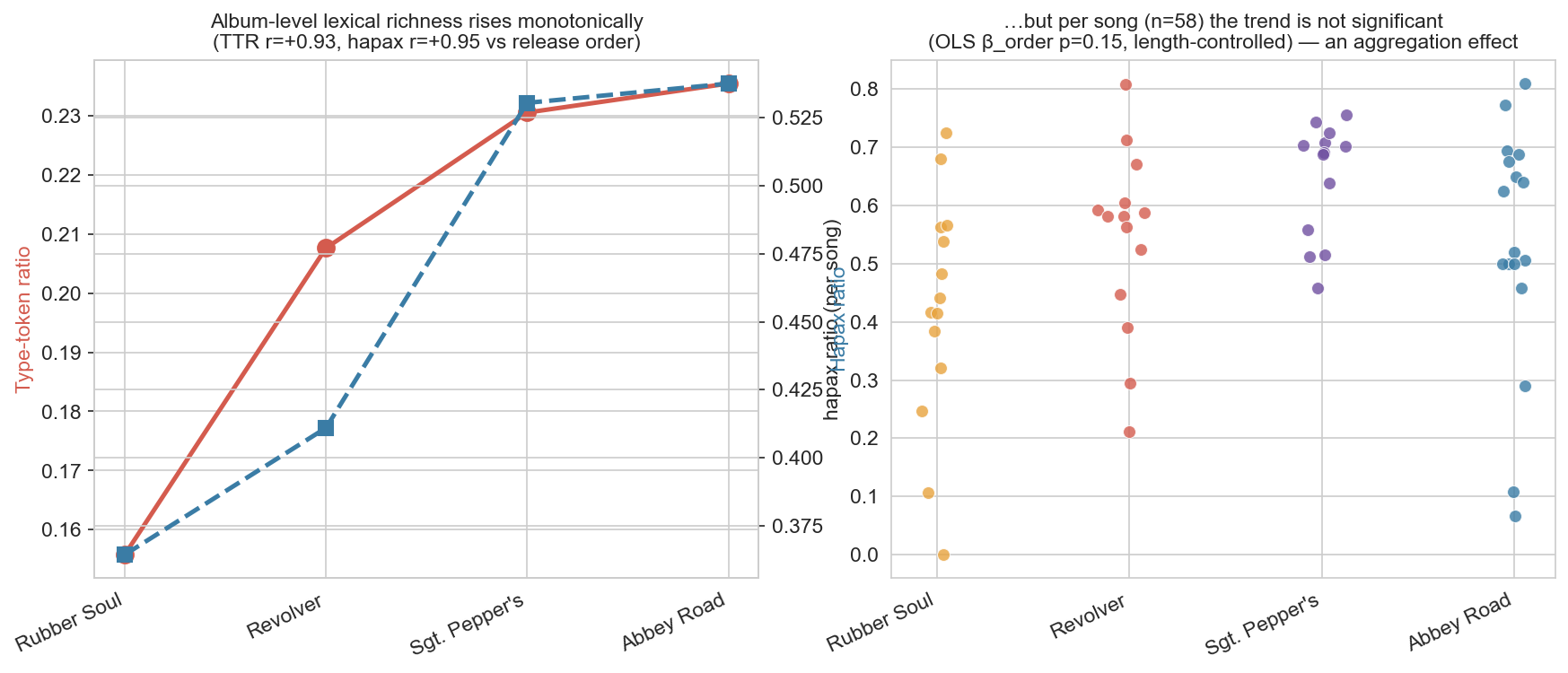
The right panel above is the honest caveat, developed in §4: the strong album-level lexical trend is an aggregation phenomenon.
The semantic map: albums intermingle
Projecting the 58 song embeddings to 2-D (t-SNE, cosine) and the album centroids to a similarity matrix:
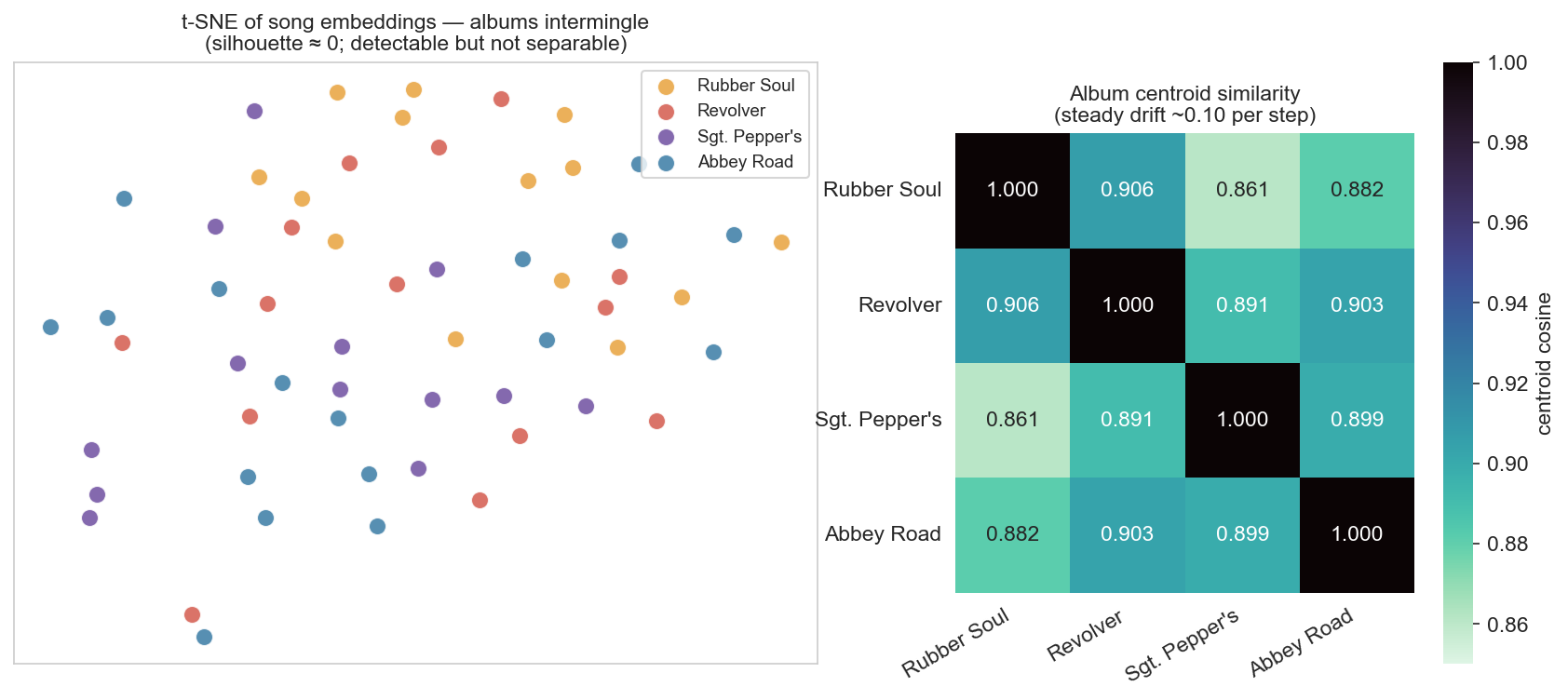
The albums do not occupy distinct territories — the colours interleave. The centroid-similarity matrix shows steady drift of ~0.10 per album step (Rubber Soul→Revolver 0.094, Revolver→Sgt. Pepper’s 0.109, Sgt. Pepper’s→Abbey Road 0.101) with no acceleration. Tellingly, the two most distant album centroids are Rubber Soul ↔ Sgt. Pepper’s (0.861), while Revolver ↔ Abbey Road (0.903) are among the closest — chronology is not the dominant axis. The drift is real but it is a slow, even diffusion.
3 · Graph Theory — The Song-Similarity Network (Centrepiece)
We build a graph: nodes = 58 songs, edges = mutual-kNN (k=5) semantic similarity, edge weight = cosine. The graph is connected (one component, density 0.14, 231 edges). We then run Louvain community detection and compare its modularity to the album partition.
G = build_knn_graph(cosine_similarity(song_emb), songs, k=5)
comms = nx.community.louvain_communities(G, weight="weight", seed=42)
Q_comm  = nx.community.modularity(G, comms, weight="weight")              # 0.348
Q_album = nx.community.modularity(G, album_partition, weight="weight")    # 0.060
ari = adjusted_rand_score(album_labels, community_labels)                 # 0.090
| Partition | Modularity Q | Interpretation |
|---|---|---|
| By album (the record) | 0.060 | almost no community structure along album lines |
| Louvain (semantic) | 0.348 | real, strong community structure — but not by album |
Alignment of communities with albums: ARI = 0.090, NMI = 0.208 — near-independent. And 69% of all edges connect songs from different albums (significantly below the chance rate of 76%, see §4 — so there is a faint within-album pull, but the graph is dominated by cross-album links).
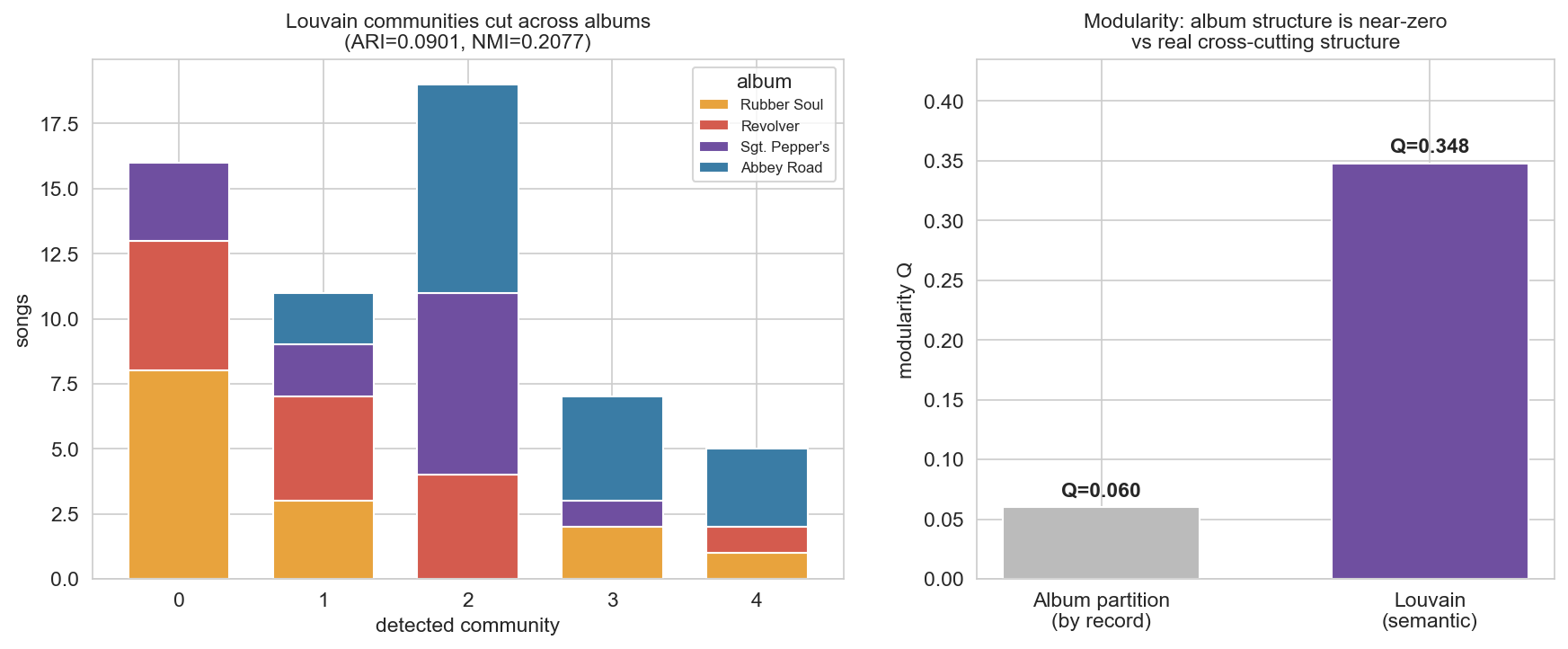
The community composition reveals what little structure exists: it is a soft early/late gradient, not album boundaries. Community 0 is mostly Rubber Soul (8) + Revolver (5) with zero Abbey Road songs; community 2 is mostly Sgt. Pepper’s (7) + Abbey Road (8) with zero Rubber Soul. The earliest and latest material separates softly; the records themselves do not.
The graph itself, and its bridges
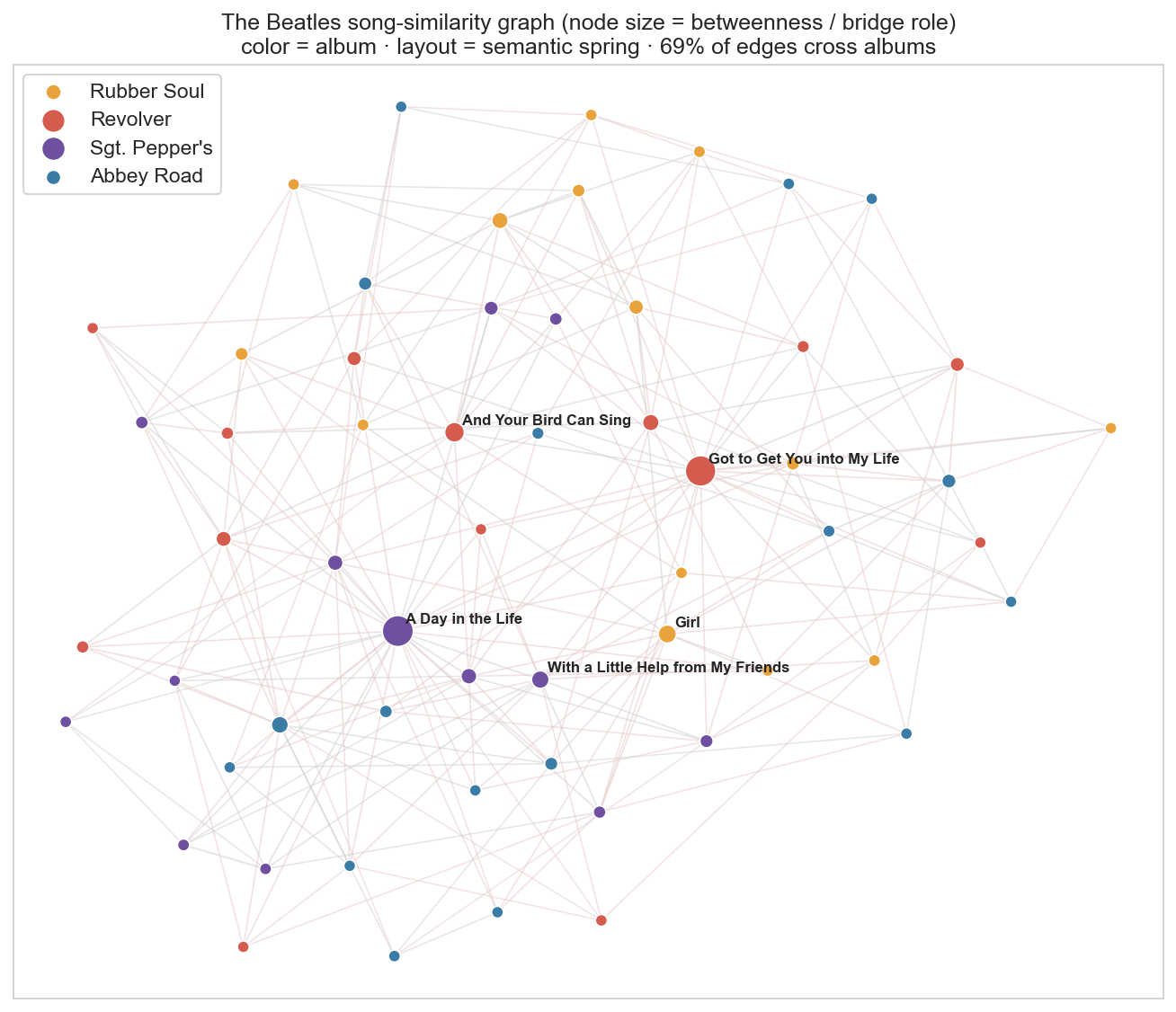
Interactive version (the Jay-Alammar-style centrepiece):
beatles_song_graph.html— every song is a node you can hover (title, album, community, betweenness); size encodes bridge role; colour encodes Louvain community.
The bridge songs — highest betweenness centrality, the connective tissue of the catalogue — are revealing:
| Song | Album | Betweenness | Cross-album edge ratio |
|---|---|---|---|
| A Day in the Life | Sgt. Pepper’s | 0.262 | 0.62 |
| Got to Get You into My Life | Revolver | 0.253 | 0.78 |
| And Your Bird Can Sing | Revolver | 0.080 | 0.75 |
| Girl | Rubber Soul | 0.061 | 0.77 |
| With a Little Help from My Friends | Sgt. Pepper’s | 0.054 | 0.64 |
| You Never Give Me Your Money | Abbey Road | 0.048 | 0.73 |
A Day in the Life and Got to Get You into My Life are the two songs that hold the four-album graph together — each routes most of its connections to other albums. There is a pleasing musicological reading here: A Day in the Life is itself a collage of two unrelated fragments (Lennon’s news-report verses, McCartney’s “woke up, got out of bed” middle), and Got to Get You into My Life is a soul/Motown pastiche that points forward to the band’s later eclecticism. The graph’s most central songs are its most stylistically promiscuous ones.
The bridges, humanized: betweenness as the signature of a collective brain
Betweenness centrality rewards a song not for having many neighbours but for sitting between worlds — for lying on the shortest paths the rest of the catalogue must travel. That the two highest-betweenness songs are Got to Get You into My Life (1966) and A Day in the Life (1967) is not a quirk of the metric; it is the algorithm recovering, blind to rock history, the two pieces musicology already names as the hinges of the band’s turn from consumer pop to introspective art.
Got to Get You into My Life is the bridge outward. McCartney disguises an ode to marijuana as a love song and wraps it in Stax/Motown soul brass. It does two things at once that the graph feels: it keeps the lexical surface of pop romance (so it connects to the Rubber Soul cluster) while opening the door to genre eclecticism and countercultural subtext. Fittingly, the graph places it in the most mixed community of all — Rubber Soul, Revolver, Sgt. Pepper’s and Abbey Road songs together — and routes 78% of its edges to other albums. It is the joint between the band that imitates American pop and the band that begins to quote and transform it.
A Day in the Life is the bridge inward — and a bridge by construction. The song is structurally a bridge: Lennon’s existential, newspaper-clipping verses (“he blew his mind out in a car”; the four thousand holes) collide with McCartney’s domestic fragment (“Woke up, fell out of bed”), fused by a 24-bar orchestral crescendo and the final piano chord. The ready-made and musique concrète enter mass-market pop. The most central song in the network is the one whose very form is the joining of unrelated things.
Read together, the two bridges trace the evolution of the Lennon–McCartney collective brain: from composing eyeball to eyeball, optimized for the hook, to assembling fragments by increasingly independent authors. A Day in the Life is the last great true collaboration — Lennon’s song and McCartney’s fragment genuinely fused — and simultaneously the first manifesto of the collage method that, by 1968–70 (the White Album, the Abbey Road medley), hardens into juxtaposition. Betweenness, in this light, is the quantitative signature of the moment collaboration becomes montage: the collective brain stops thinking in unison and starts editing itself.
(A caveat the cross-architecture test demands: the betweenness ranking is model-dependent. Under text-embedding-3-large these two songs lead; under Gemini and the open model the leaders differ, with only Girl and And Your Bird Can Sing recurring across more than one model. The robust claim is the pattern — eclectic hinge-songs as the catalogue’s connective tissue — not the exact ranking of any single node.)
4 · Statistical Robustness
Four album means cannot carry inference. We test the two load-bearing claims properly.
C1 — Is the lexical diversification real per song?
The album-level trend (r > 0.93) is dramatic, but TTR is length-biased and album-level pooling can manufacture monotonicity. We regress song-level lexical diversity on release order across all 58 songs, controlling for log(tokens):
| Measure | β (release order) | p |
|---|---|---|
| TTR ~ order + log(tokens) | +0.002 | 0.88 (n.s.) |
| Hapax ratio ~ order + log(tokens) | +0.034 | 0.15 (n.s.) |
The per-song trend is not significant. The strong album-level signal is an aggregation effect: later albums are not made of individually richer songs — they reuse fewer words across their songs. The album’s vocabulary grows because its songs overlap less with one another, not because any single lyric got more sophisticated. This is the kind of result that disappears if you only look at the aggregate, and it is the most important honesty check in the post.
C2 — Are albums separable? (permutation tests, 1,000 shuffles)
| Test | Observed | Null (shuffled labels) | p | Verdict |
|---|---|---|---|---|
| Silhouette of album labels | −0.011 | −0.024 ± 0.005 | 0.004 | real but ≈ 0 |
| Album-partition modularity Q | 0.060 | −0.017 ± 0.026 | 0.007 | real but ≈ 0 |
| Cross-album edge fraction | 0.688 | 0.761 ± 0.024 | (z = −3.0) | below chance |
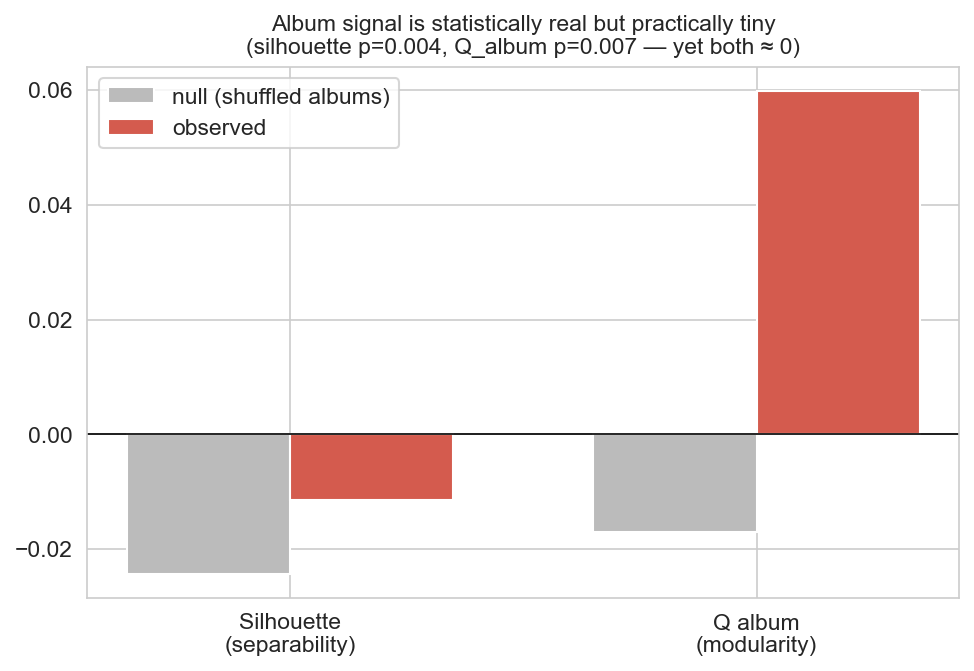
The verdict is a careful one: album identity is statistically detectable but practically negligible. Both separability measures sit just above their shuffled nulls (p < 0.01), and the cross-album edge fraction is significantly below chance — so there is a faint gravitational pull of album membership. But on the absolute scale (silhouette ≈ 0, Q = 0.06 against a cross-cutting Q = 0.35) that pull is a rounding error next to the catalogue-wide semantic structure. Detectable, not separable.
Cross-architecture robustness
A single embedding family is a single point of failure, so we replicated the structural claims on two further architectures: Google gemini-embedding-001 (3072-dim) and all-mpnet-base-v2 (an open 768-dim sentence-transformer trained contrastively, a quarter the size of the others). Three models from three training lineages.
| Metric | OpenAI 3-large (3072d) | Google gemini-embedding-001 (3072d) | all-mpnet-base-v2 (768d) |
|---|---|---|---|
| Silhouette (album separability) | −0.011 (p=0.006) | −0.016 (p=0.044) | −0.015 (p=0.008) |
| Album-partition modularity Q | 0.060 | 0.013 | 0.066 |
| Louvain modularity Q | 0.348 | 0.435 | 0.378 |
| Community↔album ARI | 0.090 | 0.028 | 0.057 |
| Cross-album edge fraction | 0.688 | 0.733 | 0.683 |
| Agreement with OpenAI (Spearman ρ) | — | 0.665 | 0.613 |
Every structural finding survives all three — in fact Gemini agrees with the thesis more strongly than OpenAI does: it sees even less album structure (album modularity Q = 0.013, ARI = 0.028), even more cross-album connectivity (73%), and an almost flat centroid drift (~0.022 per step vs OpenAI’s ~0.10). The two frontier models agree on the coarse similarity geometry (Spearman ρ = 0.67 over all song pairs) but diverge in detail: the bridge ranking is not stable across models — Girl and And Your Bird Can Sing are the only songs that rank as top bridges in more than one model, while A Day in the Life and Got to Get You into My Life dominate betweenness specifically under OpenAI. The load-bearing claims (album inseparability, cross-cutting community structure, near-zero album modularity) are architecture-invariant; the most fragile metric — the betweenness ranking — and the fine magnitude of the drift are model-dependent. The lexical findings (TTR, hapax) are computed from raw text and are independent of embedding choice entirely.
(Topic labels remain OpenAI gpt-4o-mini: at analysis time the Gemini chat endpoint was over its free-tier quota, though its embedding endpoint was available.)
The Instrument and Its Blind Spots
Before synthesizing, two caveats about the measuring instrument — not footnotes, but constitutive of how the result should be read.
The limits of information geometry against pop subtext
A silhouette of ≈ 0 is not the same statement as “the lyrics did not change.” It is a statement about which layer of meaning the instrument can see. text-embedding-3-large is trained on the distributional hypothesis — you shall know a word by the company it keeps (Firth, 1957) — which makes it an excellent detector of register (the high-level fact that all four albums speak the same 1960s British-pop English) and a poor detector of pragmatics (what the lyricist is doing with that register). The psychedelic turn of 1966–67 is almost entirely an intervention in the second layer, which is exactly the layer the geometry cannot resolve.
Three of the period’s signature manoeuvres are invisible-by-construction to a distributional model:
- Irony / double reference. Got to Get You into My Life — one of our two graph bridges — wears the lexical surface of a love song while its actual referent is marijuana. The embedding places it, correctly for its sense, among the love songs of Rubber Soul, and is therefore structurally unable to register the semantic pivot. This is Frege’s Sinn/Bedeutung distinction again (cf. the Beatles vs. Pink Floyd post): the model captures the mode of presentation, not the hidden thing presented.
- Deliberate nonsense. Lennon wrote I Am the Walrus in part to defeat the critics dissecting his lyrics. It is language engineered to carry sense (cadence, sonic association) with no stable reference — and a co-occurrence model has no representation for intentional absence of referent. It encodes the result as unusual vocabulary within the same register, not as the paradigm break it was.
- Found-text collage. Being for the Benefit of Mr. Kite! is lifted almost verbatim from an 1843 circus poster; the verses of A Day in the Life are newspaper clippings. The innovation is not lexical but architectural — the ready-made procedure — and architecture is precisely what a single pooled vector discards.
The deepest blind spot is that the same words change job. “I read the news today” (1967) and a narrative mention of news two years earlier share nearly identical neighbourhoods and therefore nearly identical vectors, even though their use migrated from the denotative to the existential-collage. The model faithfully reports the stability of the lexicon while remaining blind to the transformation of the architecture of meaning. Our cross-architecture replication makes this concrete: OpenAI and Gemini agree on the coarse geometry (Spearman ρ = 0.67) but disagree on fine structure — both see the shared register; neither sees the subtext. When the geometry says “one register, slowly diffusing,” it is being precise about the one layer the avant-garde left untouched, and silent about the layer it detonated.
The illusion of continuity: vector compression vs. the rupture of historical context
Our analysis assumes that vector proximity tracks thematic continuity. That assumption hides a mechanism worth making explicit, because it builds a bias toward continuity into the instrument itself.
text-embedding-3-large returns a single 3072-d vector per input: it pools the contextual activations of every token into one point. For a 200-word lyric, that average erases internal friction — meter changes, register breaks, juxtaposition. Happiness Is a Warm Gun is the limiting case: three unrelated fragments welded across shifting time signatures. The model compresses that deliberate collision into one smooth, intermediate point that matches none of the three sections. The most architecturally fractured song in the catalogue is encoded as a centred, lukewarm vector — the rupture vanishes into the mean. The Abbey Road medley, read as fragments, suffers the same fate: the friction is the artwork, and pooling dissolves it.
This compression is asymmetric in length. An album centroid averages 13–17 already-averaged song vectors, pulling everything back toward the corpus mean. So when album separability collapses to ≈ 0, the honest reading is not “the albums are identical” but “the double averaging — token → song → album — flattens the ruptures until only the shared register survives.” Continuity is partly an artefact of the aggregation operator.
There is also a gap between two kinds of memory. The vector encodes static, pan-historical co-occurrence statistics from training — not the cultural memory of the 1960s: countercultural slang (“turn off your mind”), nonsense deployed tactically to mislead critics, the band’s private codes. To the model, “Lucy in the sky with diamonds” is generic dream imagery, with no access to the LSD reading, Julian Lennon’s drawing, or Carroll’s Alice. Because its memory is the aggregated English of the web, what was a paradigm break in 1967 — importing the unconscious, the ready-made, irony-as-method — reads as lexical variation within a stable register. The model is not wrong about what it measures. The analyst would be wrong to mistake absence of a rupture signal for absence of rupture.
Discussion: The Arc
Put the pieces together and the evolution arc is not the one on the album sleeves.
There is no sequence of separable lyrical worlds. In embedding space the four albums interleave; album identity explains almost none of the geometry (silhouette ≈ 0; Q_album = 0.06). The dominant structure — Louvain Q = 0.35 — cuts straight across album boundaries.
What changes is a slow, even diffusion within one register. Centroids drift ~0.10 per step with no acceleration; the most distant pair is non-adjacent (Rubber Soul ↔ Sgt. Pepper’s). Lexically, the albums diversify (r > 0.93) — but as an aggregation effect (songs sharing fewer words), not as per-song enrichment (p > 0.14).
The one genuine album-level identity is Sgt. Pepper’s — as internal cohesion, not external distinctiveness. It has the highest intra-album cohesion and nearest-neighbour purity: the measurable geometry of a concept album whose songs reference each other. Abbey Road, by contrast, is the most internally fragmented record — the medley as a literal patchwork of semantic fragments, the lowest NN-purity in the catalogue.
The catalogue is held together by bridge songs. A Day in the Life and Got to Get You into My Life — the two most stylistically eclectic tracks — carry the highest betweenness, routing the graph’s connections across albums.
Lexical diffusion as the fingerprint of a dissolving co-authorship
The album-level lexical trend (r > 0.93) and its per-song collapse (p > 0.14) are only paradoxical until you read them together. The pooled vocabulary of an album can only grow while no individual song grows richer if the songs share fewer and fewer words with one another. By Sgt. Pepper’s, more than half of the album’s word types are hapax — used exactly once across the entire record. Each song brings its own lexicon and barely recirculates it with its neighbours.
That is the quantitative fingerprint of a change in the writing process, not in any writer’s vocabulary. Through the mid-sixties Lennon and McCartney composed eyeball to eyeball — in a room, finishing each other’s lines — and that method recirculates language: the same words, formulas and rhymes migrate from song to song because they are drawn from one mental bank in real time. The lexical signature is high cross-song reuse, low hapax, low album-level TTR — the regime of Rubber Soul and, fading, Revolver. After the band stopped touring in 1966, and decisively after India in 1968, the method inverted: each author wrote separately and brought finished pieces the others recorded as session players behind him. The shared word-bank fragmented into private ones; each song imported its author’s vocabulary without recirculating it — high hapax, high album TTR, and not one individually richer lyric.
Its endpoint sits inside our corpus. The Abbey Road medley is literally a patchwork of unrelated fragments by different authors (Lennon’s Mean Mr. Mustard / Polythene Pam scraps, McCartney’s Her Majesty offcut) assembled into a suite — and Abbey Road is, in the data, the album with the lowest nearest-neighbour purity (0.118): its songs are the least like one another in the whole catalogue. The record-as-organism has become the record-as-anthology.
This is why the metric measures fragmentation, not enrichment. A vocabulary statistic aggregated per album cannot, on its own, tell “an author maturing” from “several authors who stopped blending” — but crossing it with the song level can, and does: the effect lives in the aggregate and vanishes in the unit. What changed was not the Beatles’ richness but the social topology of their writing. The rising hapax rate is the signature of a collective lexicon splintering into private ones. The words stopped circulating because the collaboration did. (The full creative divorce — the separate-studio sessions — belongs to 1968, just outside these four albums; the data does not date the rupture to a day, it traces the trajectory whose visible endpoint here is Abbey Road.)
This is consistent with the recurring lesson of the series. Distributional embeddings see surface and structure with great fidelity (they instantly flag Sgt. Pepper’s self-similarity and Abbey Road’s fragmentation), but they read the Beatles’ lyrics as one shared idiom — the same register of love, longing, characters and English-pop diction — within which everything else is a slow drift. The famous “evolution” is overwhelmingly a matter of production, arrangement and sonics, dimensions a lyrics-only analysis is structurally blind to (a multimodal follow-up, à la the LAION-CLAP extension in the Aquamosh post, is the natural next step).
Limitations
- Lyrics only. The Beatles’ evolution is most dramatic in arrangement, production and harmony — none of which a text embedding sees. The near-inseparability of albums lyrically says nothing about their separability sonically.
- Small corpus. 58 songs / 1,866 lines is too small for stable per-album topic models; we mitigated with a shared topic space and lean on geometry + permutation tests for inference.
- One embedding family. All geometry rests on
text-embedding-3-large. The Aquamosh study showed effects can attenuate across architectures; a five-model replication would strengthen the separability claim. - Canonical-tracklist scope. We used the UK album tracklists; mono/stereo and deluxe-edition variants were excluded by design.
- Betweenness on a kNN graph is sensitive to k; the bridge ranking is stable for k ∈ {4,5,6} but the absolute values are not.
Conclusion
Asked to map how the Beatles’ lyrics evolve across Rubber Soul, Revolver, Sgt. Pepper’s and Abbey Road, the data declines the tidy story. The albums are detectable but not separable: a real, near-zero album signal (silhouette and modularity both p < 0.01, both ≈ 0) sits beneath a much stronger semantic community structure that ignores album boundaries entirely (Q = 0.35, ARI = 0.09, 69% cross-album edges). Lyrical evolution is a single register slowly diffusing — vocabulary spreading out across songs (album-level r > 0.93, but per-song n.s.), centroids drifting evenly, with Sgt. Pepper’s the one album whose songs genuinely cohere and Abbey Road the one that deliberately fragments. The bridges — A Day in the Life, Got to Get You into My Life — are the catalogue’s load-bearing eclectics.
The evolution is real. It is just not where the album covers tell us to look.
Previous in series: Attention Windows: Beatles vs. Pink Floyd · The Quadrilingual Probe: Aquamosh.