Intro
My idea of a perfect evening is a conversation with Sabina and Asimov about how unreal the present feels, with books by Ernest Hemingway on a nearby table.
Who I am
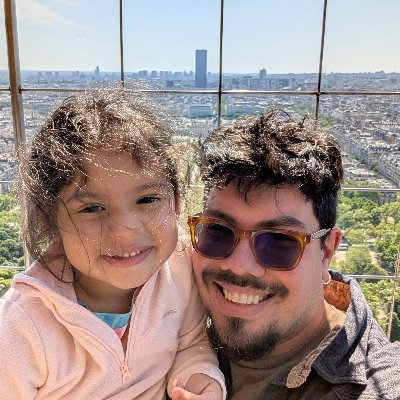
I’m Carlos Daniel Jiménez, a Colombian AI software engineer with experience in technical leadership and applied research. I studied economics, philosophy, history, and statistics, and those interests still shape the questions I bring to engineering: how we interpret evidence, how we explain uncertainty, and how ideas change over time.
My work connects two enduring interests: understanding how music and stories develop meaning, and building AI systems whose answers can be examined against their evidence. I help engineering teams reason about retrieval, agent memory, evaluation, and the architectural choices behind quality and cost.
I currently live between Sweden and El Salvador. I’ve lived in Colombia, the United States, Mexico, Chile, Sweden, Spain, and El Salvador.
I love the sea and the acoustic guitar. When I’m not coding, I’m usually reading.
Coffee, vinyl, and stories
I’m a coffee purist, with a particular interest in brewing methods. I enjoy understanding the bean, the extraction, and how each method brings out different qualities in the cup. Making coffee is a ritual of paying attention to the details.
I’m passionate about music on vinyl. What draws me in is following a band’s evolution across its discography: how its sound changes, how its lyrics develop, and how one album opens a different chapter from the last. Listening is where my questions about music begin.
I also study narrative arcs in literature: how a plot develops, how characters change, and how a later passage can reshape our reading of an earlier one. That interest in the movement of a story carries into the way I listen to albums and study their lyrics.
Music, embeddings, and narrative arcs
Music research is a central part of my intellectual work. I use embeddings, NLP, and LLM-based experiments to explore how ideas recur, change, and connect across songs and albums. I am interested in narrative arcs: what a sequence develops, what an ending makes us reconsider, and what evidence supports a particular reading.
My literary mapping experiments ask related questions about stories through vector representations and narrative maps. Close reading and listening give those representations something to answer to. Similarity in an embedding space is a starting point for interpretation; the meaning of a relationship still needs to be argued from the work itself.
These questions also lead me to LLM and agent memory. An interpretation may depend on details separated by many pages or songs. A system has to retain and retrieve the evidence that supports it. My album-memory studies examine that problem through comparisons of memory strategies, retrieval, verification, and resource use. Their findings concern the experiments and representations used; applying them to another system requires its own evaluation.
Engineering and technical leadership
I investigate how AI systems interpret meaning, retain evidence, and behave under practical constraints. In AI engineering, I publish experiments on retrieval, evaluation, agent memory, and inference optimization, with their methods and limitations available for inspection.
My professional experience has given me different ways to approach those decisions:
- Globant — former AI Software Engineering Lead: I worked end-to-end across finance, streaming, healthcare, human resources, and retail.
- Yale University School of Medicine — AI Engineer: I developed voice-to-text products with edge computing and time-series models for detecting responses to stimuli related to brain, mind, and cognition.
- Inter-American Development Bank — former Principal Data Scientist: I worked on LLM and NLP challenges, as well as risk assessment using machine learning, statistical modeling, and sampling.
- Mercado Libre — former Data Science Lead: I developed catalog autocomplete products and models for detecting anomalous activity.
- UN — former Data Scientist: I worked on geolocation models and environmental issues.
I bring that experience to architectural questions: what evidence an application needs, what it should remember, how to evaluate its answers, and which changes merit the engineering effort. I offer diagnostics and technical advisory for teams working through those questions.
I also enjoy building edge systems, with GCP as my cloud platform. One of my favorite ways to work is programming on a Raspberry Pi through Tmux and Neovim.